
Margarita (1991): Memory of the August 1991 Coup Attempt in the USSR

We continue our exploration of catastrophic memory tied to the collapse of the Soviet Union. In previous posts, I’ve discussed games such as Defending the White House (1992), Siege of the White House (1993), and Civil War (1992), all of which directly engage with the historical events of the early 1990s. But today’s game is
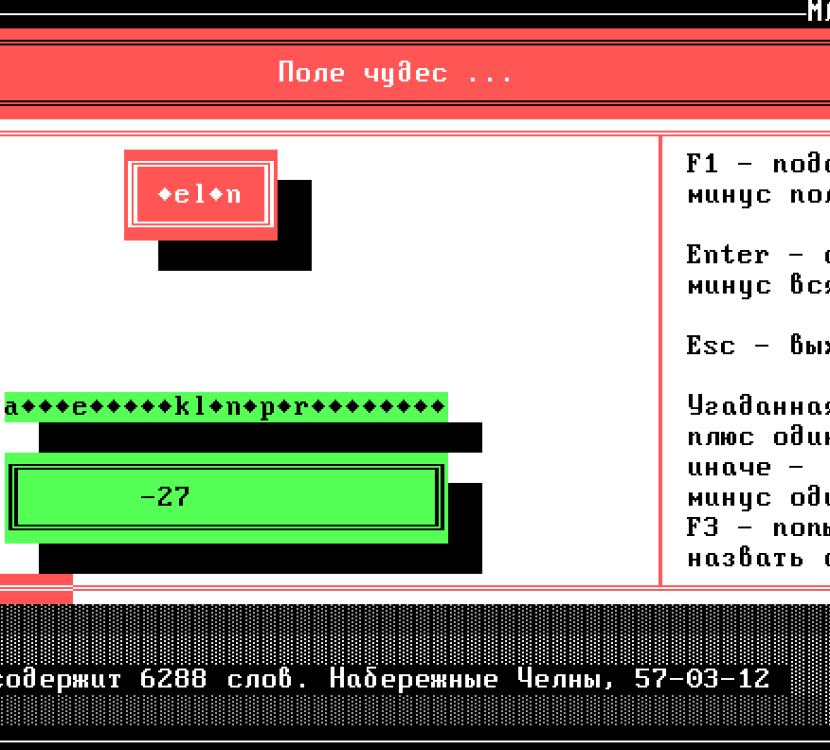
We continue our exploration of catastrophic memory tied to the collapse of the Soviet Union. In previous posts, I’ve discussed games such as Defending the White House (1992), Siege of the White House (1993), and Civil War (1992), all of which directly engage with the historical events of the early 1990s. But today’s game is something entirely different. At first glance, it appears to be just another Wheel of Fortune clone — nothing out of the ordinary, nothing foreboding.

This game, titled Margarita, was created by A. Lisovsky from Naberezhnye Chelny. It was released on August 26, 1991 — less than a week after the failed August Coup, when the State Committee on the State of Emergency (GKChP), a group of high-ranking Soviet officials opposed to Gorbachev and his Perestroika reforms, attempted to seize power in the USSR.

So… What’s the gameplay? Margarita quickly sank into the sea of lookalike TV quiz show clones. After the release of the beloved on the post-Soviet space Pole Chudes (1993) (Pole Chudes – is a Soviet and after that Russian TV clone of Wheel of Fortune) video game by Vadim Bashurov (whose other game Shkalik explores Gorbachev’s anti-alcohol campaign — covered earlier on this web-site), interest in other similar titles largely faded. Only recently, in May 2025, was Margarita rediscovered by the Russian retro gaming community.

At first, there doesn’t seem to be anything remarkable about the game — and for the most part, there isn’t. The core gameplay revolves around guessing words, but not Russian words — English ones. In fact, Margarita isn’t a conventional Wheel of Fortune clone at all, but rather an educational program for language learning. Players could even load their own vocabulary files — including not just natural languages but also programming ones.

And then, after playing for a while, you go to quit the game — and that’s when you encounter this striking message: “Note: the title, music, and color scheme of this game were selected before the August coup d’état in the USSR, and accordingly, before the revolution carried out in the country thanks to the leadership of Russia and its people. After much reflection, the author decided to preserve the game’s original name, color palette, and soundtrack as a monument to history and culture — in place of the mindlessly destroyed monument on Lubyanka (this is the monument of Felix Dzerzhinsky who was a leader of OGPu – the state security police. A.V.). — A. Lisovsky, August 26, 1991” (In-game message // Margarita, 26.08.1991)

Margarita contains no attempt at historical reconstruction, as we find in Siege of the White House, nor does it offer any interpretation of events. What it provides is something quieter and arguably more powerful: a brief personal reaction embedded directly into the game code, written in the emotional aftermath of the failed coup. It doesn’t retell history — it registers it. And in doing so, Margarita becomes a document of emotional immediacy: a flash of memory, uncertainty, and symbolic defiance in response to a system on the verge of collapse.

Previous:
White House (1994): Memory of the Russian White House Shelling
Next:
In the Name of the Party! (TBA): A Podcast Interview with the Developers of a Game Set in the Samosbor Universe (in Russian)