
The Russian Fan Translation of Sid Meier’s Civilization I (1993): A Collision of Memory

I remember the moment vividly — the first time I launched the original Civilization. It was a late evening sometime around 1994 or 1995. After finishing my homework, I sat down at my PC. Wanting to play a little, I inserted a disc from one of those legendary Russian pirate collections like “100 (200, 500,
I remember the moment vividly — the first time I launched the original Civilization. It was a late evening sometime around 1994 or 1995. After finishing my homework, I sat down at my PC. Wanting to play a little, I inserted a disc from one of those legendary Russian pirate collections like “100 (200, 500, etc.) Best Games for IBM PC”. Browsing through the folders, I came across a title that caught my eye — Civilization. Already a history nerd by then, I couldn’t resist. I installed the game — and before I knew it, the sun was rising (luckily it was Friday night).
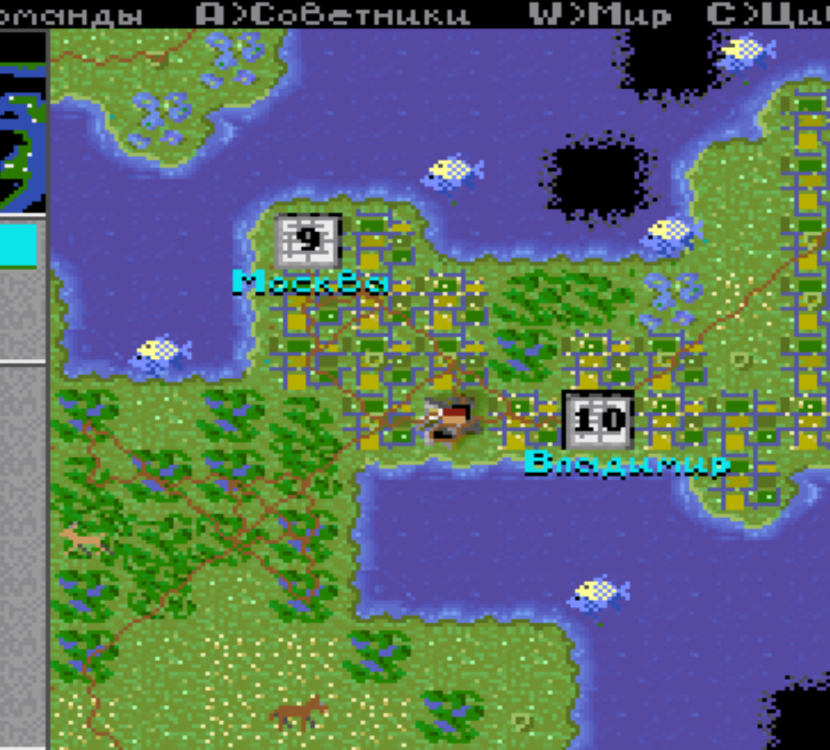
Despite the game’s clunky interface, it offered a wealth of possibilities and a revolutionary-for-its-time gameplay loop centered on building your own civilization from scratch. But what amazed me even more — the game was fully translated into Russian! The translation was so polished that for years I was convinced it must have been official.
Russified!
What struck me most, though, was how respectfully Sid Meier — or so I thought — had treated what I saw as “our”, i.e. contribution to global progress.
Moscow, Before the Arrival of Communism
As I neared the end of the game — the phase where you begin constructing the spaceship to colonize Alpha Centauri — I was stunned to discover that the wonder required for this was the Vostok Program!
The city of Zimbabwe has built the Vostok Program
To my later disappointment, I found out this translation was not official. There was no such thing as the “Vostok Program” in the original game — the wonder in question was, of course, the Apollo Program. What’s more, the anonymous localizers didn’t just rename the wonder — they rewrote its entry in the in-game encyclopedia, the Civiliopedia.
Apollo Program (Original)

Fan Translation (Vostok Program):
The Vostok Program marked the USSR’s first achievement in space flight. Crushing American hopes of being the first in space, the spacecraft “Vostok” placed a man — Yuri Gagarin — into Earth orbit. Initially, Soviet politicians hoped to be the first on the Moon too, but when they realized they wouldn’t make it, they “allowed” the Americans to land there first.

Fan Translation (Vostok Program)

In this version, the “response to early Soviet successes” becomes the crushing of American hopes, and the Moon landing happened only because the Soviets graciously “allowed” it — since they realized they wouldn’t make it in time.

But it didn’t stop there. Another wonder that made me proud as a kid — the Kurchatov Project— turned out, in the original game, to be the Manhattan Project.
Manhattan Project (Original)

Kurchatov Project (Fan Translation):
The atomic bomb gets its power from the rapid release of nuclear energy. The Kurchatov Project began during World War II, following America’s lead, with the goal of learning to build atomic bombs. The first atomic explosion occurred in 1949,

Kurchatov Project (Fan Translation)
The translated version avoids naming who built the bomb first. It simply says the Soviet program began “after America’s,” but omits the fact that the U.S. had a nuclear monopoly for several years. It also leaves out the widely acknowledged role of atomic espionage in the Soviet project. Where the original highlights nuclear deterrence as a reason for peace, the translation merely notes that the arms race continues.
But perhaps the most striking reinterpretation was in the description of Communism.
Communism (Original)
Communism (Fan Translation): Communism is a system of social organization where there is no private property and the means of production (factories and plants) are owned by everyone (i.e., by no one). Experiments with this system appeared in different places throughout history, but according to Nikita Khrushchev, it reached its peak in the USSR in the 1980s. In the USSR, communism emerged through the manipulations of clever politicians exploiting the trust of the working class in their desire to improve their living standards. The first ideas of communism were proposed by Marx and Engels in Germany based on an analysis of class structures and production relations of the time.
Communism (Fan Translation):
How Khrushchev could have claimed that communism peaked in the 1980s is unclear — he died in 1971. Most likely, this is either a typo (perhaps the authors meant “was supposed to peak”) or a misremembered allusion to Khrushchev’s famous 1961 speech at the 22nd Party Congress, where he promised communism would be achieved in the USSR by 1980. As we — and the translators — know, that didn’t happen.
Other lines, like the notion that “the means of production belong to everyone (i.e., to no one)” or that communism emerged in the USSR through “manipulation of the working class,” are entirely the translators’ own inventions — revealing their emotional stance toward the ideology of the country they once lived in.
The translators’ version of the text reflects the emotions and experiences of a segment of Post-Soviet society — one still marked by unhealed wounds from its interactions with the Soviet state. When faced with an alternative, Western memory — one imported through a previously unimaginable wave of cultural products — they responded not with rejection but with appropriation. They embedded their own memory into the game.
In doing so, they gave players — at least within the world of Civilization — the chance to build the world they themselves would have wanted to see.
Previous:
Sid Meier’s Civilization IV (2005): The Kremlin in Games