
The Battle for the Black Sea (1992): The Russia–Ukraine Full-scale Conflict Before 2022

Disclaimer: This post includes references to events that echo the current war in Ukraine. If that is something you’re not comfortable with, please consider stopping here.I remember it almost like it was yesterday. It was 1993 or 1994. I had just come home from school, eaten lunch, sat down at my 486 (a personal computer
Disclaimer: This post includes references to events that echo the current war in Ukraine. If that is something you’re not comfortable with, please consider stopping here.
I remember it almost like it was yesterday. It was 1993 or 1994. I had just come home from school, eaten lunch, sat down at my 486 (a personal computer based on the Intel 80486 processor), and decided to go through a stack of floppy disks with new games — ones my father had brought home from his colleagues at the computing lab. As I sorted through the disks, I came across one labeled with a title that felt so familiar, so dear: “Naval Battle”. I decided to start with that one.
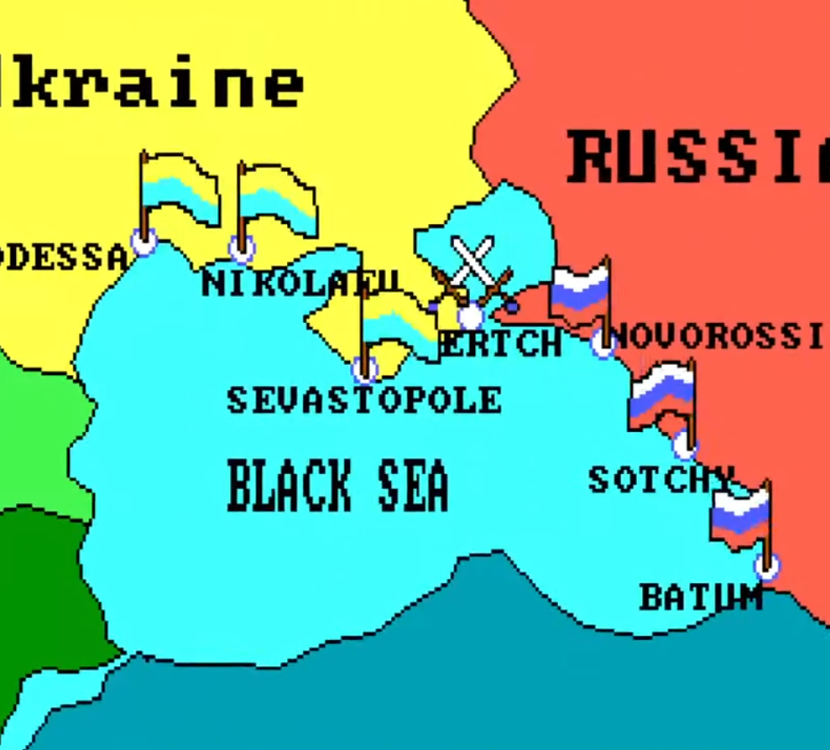
Yes, it was indeed a naval battle — but it was about a hypothetical military conflict between Russia and Ukraine in the Black Sea. (In fact, the game’s title was The Battle for the Black Sea.) The player — and you could only play as Russia — had to capture Ukrainian ports one by one: Kerch, Sevastopol, Mykolaiv, and Odesa. If you lost, the gameplay shifted to defending your own cities — Novorossiysk, Sochi, and, oddly enough, Batumi, which in the game’s world belonged not to Georgia but to Russia.
Later, as a teenager, I came to understand that the game — released in 1992 — was shaped by the dissolution of the USSR and the ongoing division of the Black Sea Fleet. According to Vadim Bashurov, the game’s developer:

Everything that happened in the real world was reflected in poetry and computer games. The breakup of the country led me to create ‘Naval Battle’. A war between Russia and Ukraine. I drew the ships and map myself. I love Crimea — I know it by heart from Kerch to Sevastopol. The Ukrainian flag was based on descriptions from Bulgakov — yellow and blue. Today people rightly criticize me for reversing the flag’s colors.(Vadim Bashurov, “Toy Story: Wheel of Fortune,” Habr, 18.07.2011 // https://habr.com/ru/articles/124363/)

One notable feature of the game was that it included both Russian and English language options. Bashurov explained this by noting that in the early 1990s, while working at the All-Union Research Institute of Experimental Physics in the closed city of Arzamas-16, he earned no more than $20 a month — and hoped to sell the game to Western audiences to make a bit of money for his family.

Previous:
Su-27 Flanker (1995): The Russia–Ukraine Full-scale Conflict Before 2022
Next:
Sid Meier’s Civilization IV (2005): The Kremlin in Games