
Sid Meier’s Civilization IV (2005): The Kremlin in Games

Have you ever noticed how many international celebrities, when visiting Red Square, tend to pose not in front of the Spasskaya Tower — but in front of Saint Basil’s Cathedral? Oddly enough, it was a video game that helped me understand what might be behind this choice: one of the entries in Sid Meier’s Civilization
Have you ever noticed how many international celebrities, when visiting Red Square, tend to pose not in front of the Spasskaya Tower — but in front of Saint Basil’s Cathedral? Oddly enough, it was a video game that helped me understand what might be behind this choice: one of the entries in Sid Meier’s Civilization series.
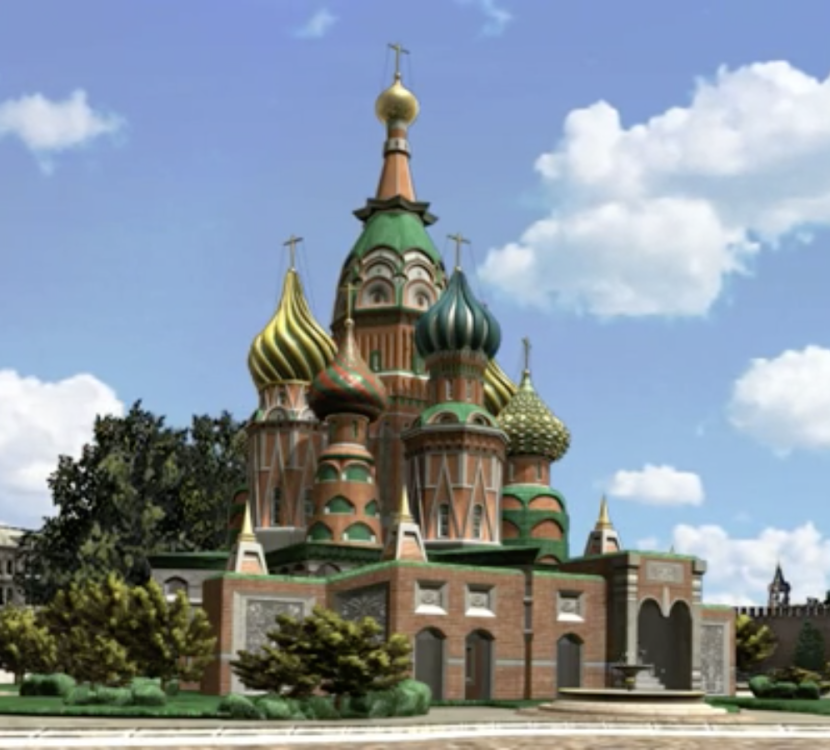
Let me explain. One of the core mechanics of the game is the construction of World Wonders — unique buildings like the Colossus of Rhodes or Petra. In Civilization IV (2005), the developers introduced a new Wonder: the Kremlin.

I still remember the anticipation of completing its construction — and the thrill of waiting to see the animated cutscene that would play once it was built. But to my surprise, the cutscene didn’t show the Kremlin. Instead, it showed the building we know as Saint Basil’s Cathedral (or the Cathedral of the Intercession of the Most Holy Theotokos, if you prefer). I’ve attached that very cutscene to this post!

Later on, I discovered that Rise of Nations (2003) does the exact same thing — under “the Kremlin,” it too presents Saint Basil’s. The same image appears on the box art for the third edition of the board game Kremlin (2014), and in the artwork for the mobile game Dominations (2015). At this point, it becomes clear: this is no coincidence. It’s a reflection of a stable visual association — the idea that, in global perception, “Kremlin” often equals “that colorful cathedral.”
“The Kremlin” in Rise of Nations (2003)
Cover of the Third Edition of the Board Game Kremlin (2014)
Artwork from the Game Dominations (2015)

To test this hypothesis, I searched YouTube for English-language videos on the history of the Kremlin — and sure enough, many of them repeated the same visual pattern.

Some YouTube Video Thumbnails for the Search Query "History of Kremlin"
So how did this happen? After all, in Russia, the word Kremlin evokes a very different image: the Spasskaya Tower, the red brick Kremlin wall, maybe even Lenin’s Mausoleum. One possible explanation is that the bright, unfamiliar look of Saint Basil’s Cathedral, combined with its proximity to the actual Kremlin and its accessibility to tourists, has visually eclipsed the Kremlin itself in Western perception — becoming the “Kremlin” for many foreign viewers.
Previous:
The Battle for the Black Sea (1992): The Russia–Ukraine Full-scale Conflict Before 2022
Next:
The Russian Fan Translation of Sid Meier’s Civilization I (1993): A Collision of Memory