Warning: Attempt to read property "post_title" on null in /home/gameshis/public_html/wp-content/plugins/elementor/core/isolation/elementor-adapter.php on line 28 White House (1994): Memory of the Russian White House Shelling – Video Games with History – Untold Stories of Cultural Memory in (Post-)Soviet Video Games
Today, October 4, marks 32 years since the tragic events of 1993, when troops loyal to President Boris Yeltsin — notably the Kantemirovskaya tank division — opened fire on the Russian White House (the House of Soviets) with tanks. These events became the climax of what would later be called the “constitutional crisis” of September–October 1993.
Here’s how it unfolded. On September 21, President Yeltsin issued Decree No. 1400 “On the gradual constitutional reform of the Russian Federation.” This decree, in violation of the then-active Constitution, dissolved the Supreme Soviet, the country’s acting parliament. The Supreme Soviet, led by Ruslan Khasbulatov, declared Yeltsin’s actions a coup d’état and appointed Vice President Alexander Rutskoy as acting head of state. In Moscow, members of parliament barricaded themselves in the White House, where makeshift defenses began to form.
On October 3, demonstrators supporting the Supreme Soviet broke through police lines, seized Moscow City Hall, and attempted to storm the Ostankino TV center — but were met with armed resistance and repelled by special forces. On October 4, Yeltsin‘s loyalist troops shelled the White House with tanks and stormed the building. Over the course of the crisis, at least 158 people were killed, and hundreds more were wounded.
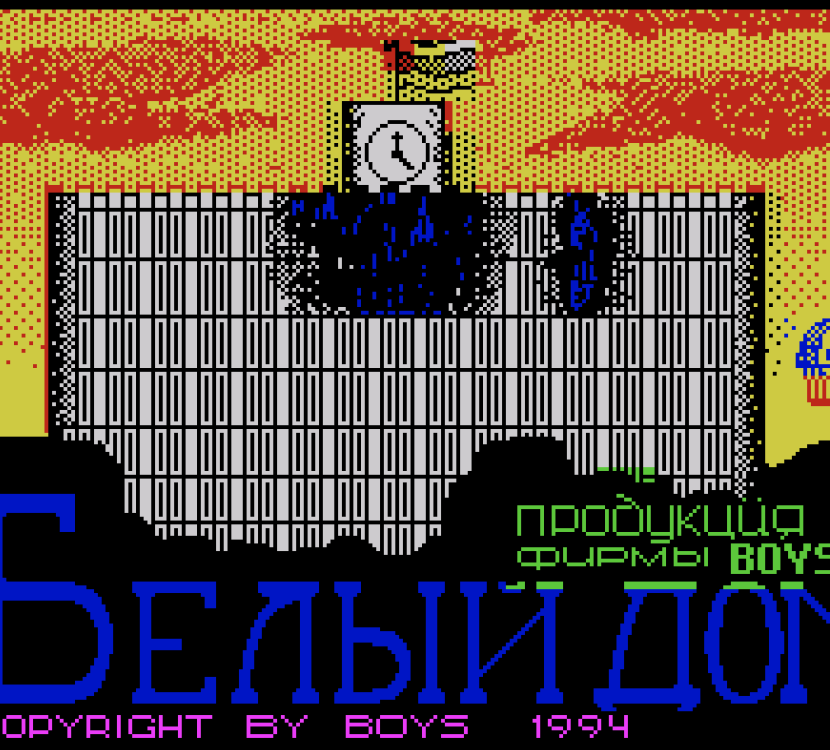
And so today, on October 4, we turn to one of the most controversial games ever made on the subject — White House (1994), released just seven months after the shelling. In this game, the developers from Boys Corporation invite players to side with Yeltsin‘s troops and take part in the shelling of the parliament. You are given a rocket launcher and tasked with shooting defenders of the White House.
“Good day, dear ZX Spectrum users! Boys Corporation offers you the chance to travel back in time and take part in the events of October 1993. Your task is to eliminate militants in the windows of the White House using a rocket launcher. You have only a few seconds and three lives. Good luck with this dangerous mission.” (In-game text)
With every successful shot, flames engulf more and more of the White House.
Until eventually, the defenders surrender to riot police (OMON) forces loyal to Yeltsin. If the player succeeds, the final screen shows them arresting the remaining survivors.
White House is not the only game to “simulate” the 1993 events. We previously covered Siege of the White House (1993) by NIKITA, which offered a similar interpretation of the tragedy:
These games do more than recall the past — they participate in the struggle over how that past is interpreted and emotionally processed. White House (1994) and Siege of the White House (1993) are examples of selective memory encoded in media form: rather than preserving a complex or plural memory, they assert one political perspective as “correct,” erasing alternatives.